
I do not make these breakfasts because I am being virtuous.
I make them because something in my body says: not a smoothie today. Something warm. Something with weight to it. The kind of morning where the thought of a green drink feels like a betrayal of what you actually need — and what you actually need is eggs, or butter, or something that takes ten more minutes and is worth every one of them.
These are not elaborate. They are not Sunday-brunch productions. They are the seven breakfasts I return to because each one does something specific — for energy, for focus, for the slow-morning feeling of being genuinely fed rather than just not hungry. Every ingredient has a reason. None of them require anything you do not already have.
Pick the one that sounds like your morning. Make it once. See what happens.
Why I stopped eating breakfast on autopilot
There is a version of breakfast that most of us eat without thinking. Toast. A bowl of something from a box. Eggs scrambled fast in a pan that was too hot, eaten standing over the sink. It is fuel in the loosest sense of that word — it keeps you upright until lunch, and that is about all it does.
What changed things for me was starting to pay attention to how the rest of my morning felt depending on what I had eaten. When I used butter instead of oil, I stayed focused longer. When I added an anchovy to the eggs, everything tasted sharper and more like itself. When I took ten minutes to make yogurt with warm spiced butter instead of grabbing something cold, the morning felt different from the inside — steadier, more like I had actually started it rather than just begun moving through it.
None of this is complicated. All of it is specific. These seven breakfasts are that kind of specific — each one designed around a state I recognise, with ingredients chosen for what they actually do rather than how they sound.
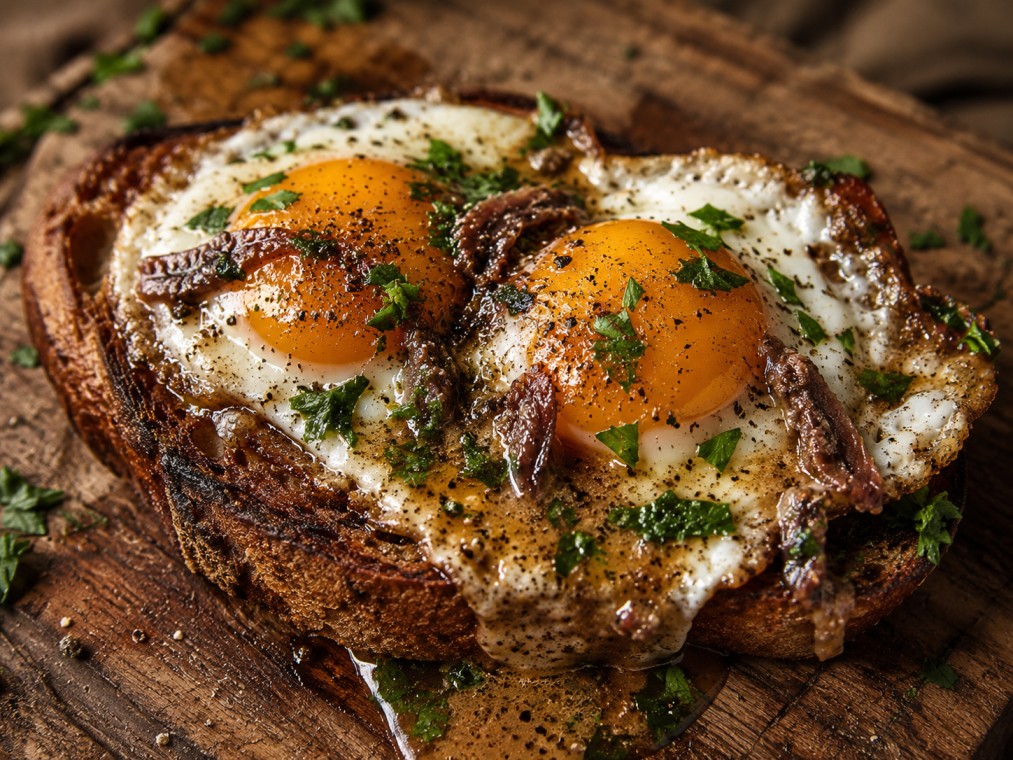
1. The “I need to think clearly before 9am” breakfast — Brown butter eggs on sourdough with anchovy
Prep time: 8 minutes | Serves: 1 | Approx. calories: 480 | Protein: 22g | Fat: 28g
When to make this: When your brain is already running two tracks before you have gotten out of bed and you need it to sustain that without breaking down by eleven. When you have a difficult conversation ahead, or a presentation, or something that requires you to actually be present and not just physically in the room.
The combination of eggs and anchovies is one of those things that sounds like it should be strange and tastes immediately, unmistakably right. The anchovies dissolve entirely into the brown butter and become something else — not fishy, not assertive, just deeply savoury in a way that makes every other flavour in the pan sharper and more alive.
Eggs are the highest-quality dietary source of choline, a nutrient your brain uses to produce acetylcholine — the neurotransmitter directly responsible for focus, memory consolidation, and sustained attention. Two eggs in the morning delivers roughly half your daily choline requirement in one sitting. Brown butter adds fat-soluble vitamins A and K2 and the kind of slow-burning energy that does not spike and crash. Sourdough — real sourdough, fermented properly — has a lower glycaemic response than regular toast because the fermentation process partially breaks down the starches. Your blood sugar stays even. You stay even.
Ingredients
- 2 large eggs
- 1 tablespoon unsalted butter
- 2 anchovy fillets in olive oil — the good tinned kind, not the jarred paste
- 1 thick slice sourdough, toasted
- A handful of fresh flat-leaf parsley, roughly torn
- Black pepper, generously
- Optional: a squeeze of lemon at the end
How to make it
Melt butter over medium heat and let it go past foaming — wait for the milk solids to turn golden and smell like hazelnuts. Add the anchovies and stir; they will dissolve within 30 seconds. Crack the eggs directly into the pan and leave them alone for 90 seconds, then tilt the pan and baste the tops with the butter until just set. Slide onto the toast. Add parsley and black pepper. Eat immediately, before the bread softens.
Why it works: Egg choline supports sustained acetylcholine-driven focus. Brown butter fat-soluble vitamins and slow-release energy prevent mid-morning crash. Anchovy glutamates deepen flavour without requiring extra seasoning. Sourdough fermentation lowers glycaemic response compared to standard bread. You will not be thinking about food again before noon.
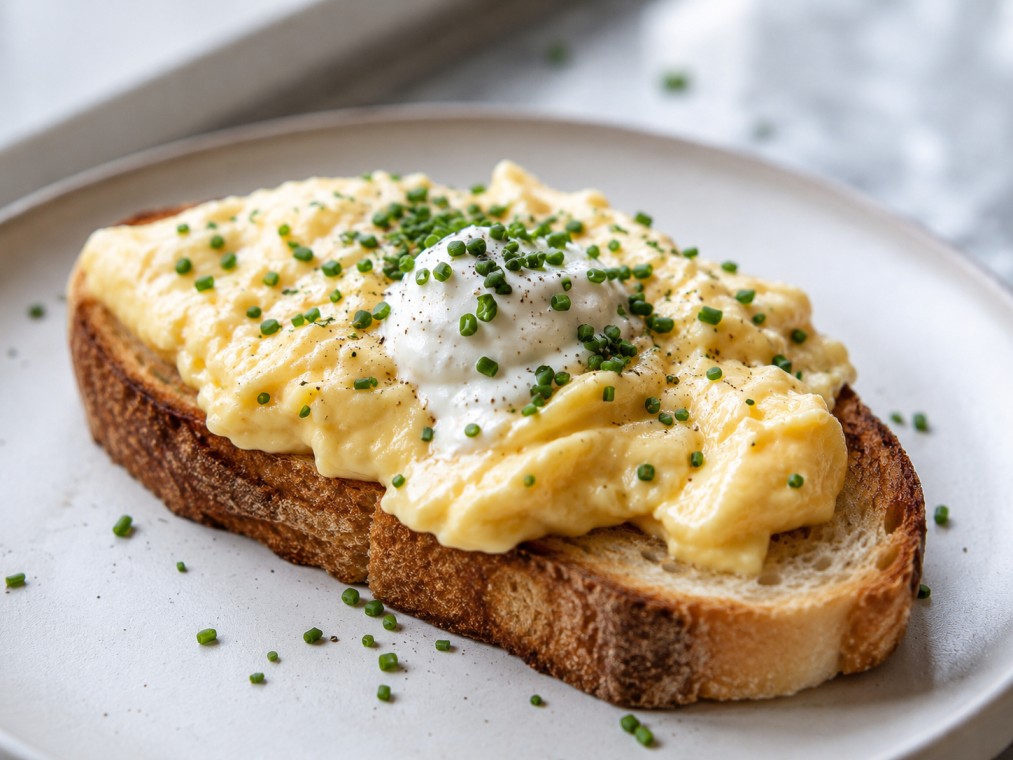
2. The “I am cold and tired and the week has already been long” breakfast — Soft-scrambled eggs with crème fraîche and chives
Prep time: 10 minutes | Serves: 1 | Approx. calories: 390 | Protein: 19g | Fat: 30g
When to make this: When it is grey outside and you have not slept quite enough and you want something that feels like being taken care of. When the idea of a vigorous morning routine is almost offensive. When comfort is not indulgence — it is genuinely what you need to be functional.
Soft scrambled eggs require nothing except patience and low heat. The technique is everything: cold pan, cold butter, cold eggs, and then the lowest flame you can manage, stirring constantly and pulling the pan off the heat before they look done. The residual heat finishes them. What you end up with is something between a custard and a cloud — barely set, trembling, nothing like the rubbery thing that happens when you rush.
Crème fraîche does two things: it stops the cooking the moment you add it, because the cold fat arrests the proteins, and it adds a gentle acidity that makes the eggs taste more like themselves. Chives are not decorative. They contain quercetin, an anti-inflammatory flavonoid, and allicin precursors that support cardiovascular function in the same family of compounds as garlic. You are not just adding colour. You are adding something with a reason.
Ingredients
- 3 eggs — room temperature if possible
- 1 tablespoon cold unsalted butter, cubed small
- 2 tablespoons crème fraîche
- A small bunch of fresh chives, finely cut
- Flaky sea salt and white pepper
- Toast or buttered brioche to serve
How to make it
Cold pan. Add eggs and butter together — do not whisk first, do not add milk. Medium-low heat. Stir slowly and constantly with a silicone spatula, scraping the bottom in wide figure-eights. The moment large, glossy curds begin to form and the mixture looks 70 percent set, pull off the heat completely. Add crème fraîche and stir through — the eggs will finish cooking from residual heat and the crème fraîche will bring them to just the right consistency. Season only after cooking; salt added before toughens the proteins. Serve immediately on warm toast.
Why it works: Low heat and fat from butter and crème fraîche keep proteins from tightening, producing a silky, custard-like texture. Chive quercetin reduces low-grade inflammation. Egg yolk lecithin supports cell membrane integrity and mood-stabilising neurotransmitter function. The whole meal is cooked and eaten in ten minutes and leaves you feeling warm from the inside in a way that coffee never quite does.
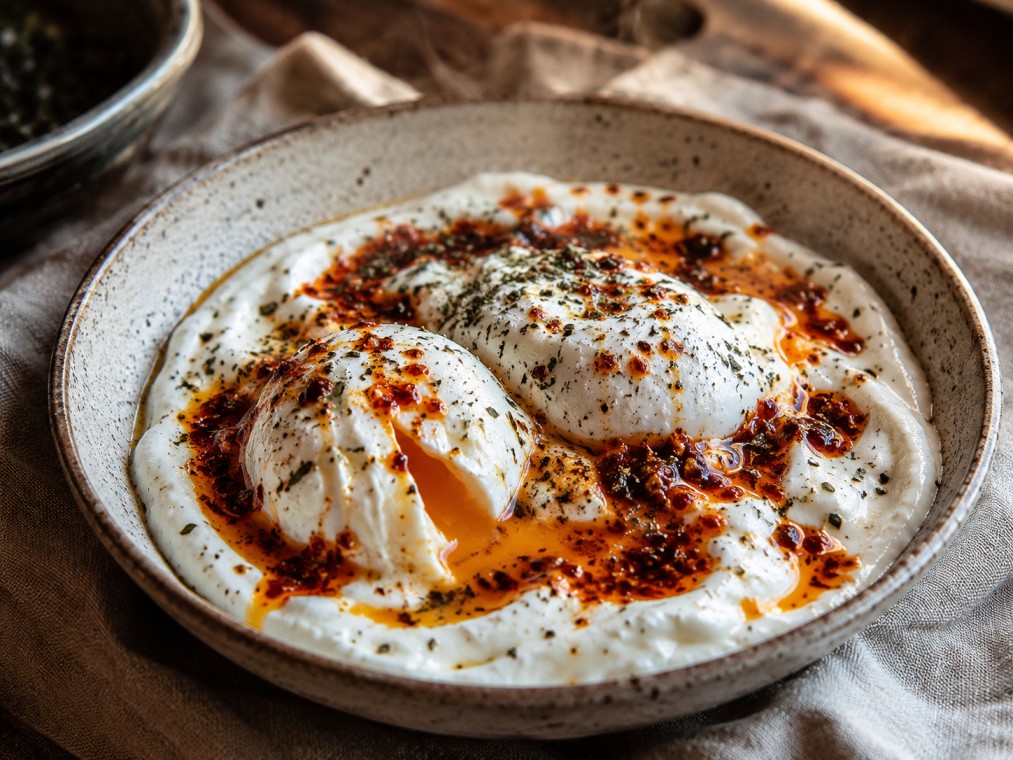
3. The “I have a long physical day ahead and I cannot be thinking about lunch by eleven” breakfast — Turkish eggs with yogurt and chilli butter
Prep time: 12 minutes | Serves: 1 | Approx. calories: 420 | Protein: 24g | Fat: 27g
When to make this: When you are going somewhere that requires your body and your brain at the same time. When you need a breakfast that sticks — not heavily, not uncomfortably, just solidly, with staying power built into its structure. When you want something that feels like a real meal without taking an hour to make.
Çilbir — Turkish poached eggs on cold yogurt with hot spiced butter — is the breakfast that makes the most people ask for the recipe. The contrast of temperatures is part of it: the cold yogurt and the warm egg and the sizzling butter poured over the top, all arriving on the same spoon at the same time. But what makes it genuinely sustaining is the protein structure: Greek yogurt provides casein protein, which is slow-digesting and keeps you satiated for three to four hours. The poached egg adds fast-digesting whey-adjacent proteins that kick in first. Together they give you an immediate and a sustained energy curve rather than a single peak.
The chilli butter is not optional. It is the thing that makes it çilbir and not just eggs on yogurt. Pul biber — Turkish red pepper flakes — is sweeter and less aggressive than regular chilli and has a fruity depth that ordinary chilli flakes do not. It is worth finding.
Ingredients
- 2 eggs, for poaching
- ½ cup full-fat Greek yogurt, at room temperature — cold yogurt makes the egg cool too fast
- 1 small garlic clove, grated
- 2 tablespoons unsalted butter
- 1 teaspoon pul biber (Turkish red pepper flakes) — or use regular chilli flakes if you cannot find it
- ½ teaspoon dried mint
- A pinch of smoked paprika
- Flaky salt
- Crusty bread, to serve
How to make it
Stir the grated garlic into the yogurt with a pinch of salt. Spread it in a wide, shallow bowl and let it come to room temperature while you do everything else. Poach the eggs in barely simmering water with a splash of vinegar — 3 minutes for a runny yolk. While the eggs poach, melt the butter in a small pan over medium heat until it begins to foam. Add the pul biber, dried mint, and smoked paprika. Stir for 30 seconds — the butter will turn deep red and smell extraordinary. Lay the poached eggs on the yogurt. Pour the hot butter over the top immediately. Add flaky salt. Serve with bread for scooping.
Why it works: Greek yogurt casein protein provides slow, sustained satiety for three to four hours. Poached eggs add complete protein and choline. The butter carries fat-soluble vitamins and keeps the energy release even. Pul biber capsaicin gently increases metabolic rate and circulation. The garlic in the yogurt provides prebiotic inulin that feeds the gut microbiome you are hopefully also tending to. This breakfast keeps you until two without effort.
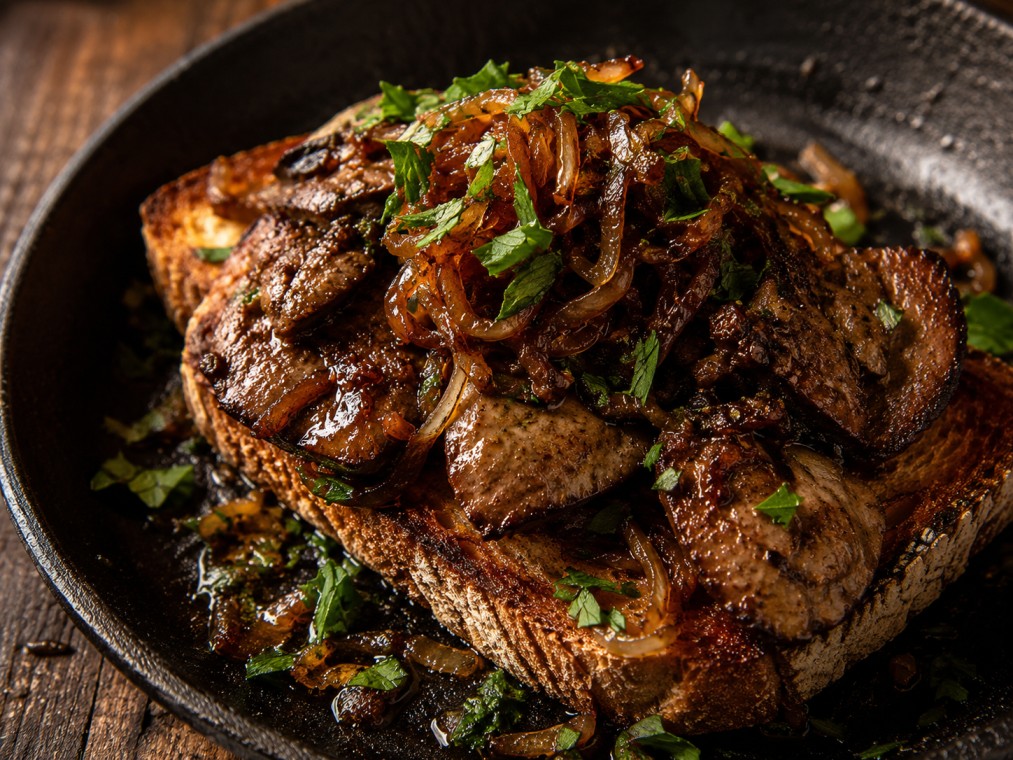
4. The “My body wants iron and I know it” breakfast — Pan-fried chicken livers on toast with caramelised onion
Prep time: 20 minutes | Serves: 1–2 | Approx. calories: 510 | Protein: 31g | Fat: 22g
When to make this: When you are pale and tired in a way that sleep does not fix. When your period has just finished and you can feel the deficit. When your nails are fragile and your hair is doing less than it should. When your body is telling you quietly, persistently, that it is running low on something specific.
I am aware that chicken livers are the ingredient that loses half the readers here. I understand. I was also that person. What changed my mind was desperation — I was genuinely iron-deficient and genuinely tired of spinach — and what kept me coming back was how good this actually is when it is made properly.
Chicken livers contain more iron per gram than almost any other food, and it is haem iron — the form that absorbs at three times the rate of plant-based iron. They are also the richest dietary source of vitamin B12, folate, and vitamin A. The tiredness, the paleness, the hair and nail fragility that iron deficiency produces are real and slow to reverse with supplements. Food-based iron, especially at this concentration, moves the needle faster. The caramelised onion is not just flavour — the vitamin C in onion enhances the absorption of the iron you are eating alongside it. This recipe is designed to work.
Ingredients
- 250g chicken livers, trimmed of any green-tinged parts and sinew
- 2 medium onions, thinly sliced
- 2 tablespoons butter
- 1 tablespoon olive oil
- 1 teaspoon fresh thyme leaves
- 1 tablespoon balsamic vinegar
- Salt and pepper
- 2 thick slices sourdough or crusty white bread, toasted
- Fresh flat-leaf parsley to finish
How to make it
Start the onions first — they take longest. Butter and olive oil in a wide pan over medium-low heat. Add the onions and a pinch of salt. Cook, stirring every few minutes, for 20 to 25 minutes until deep golden and sweet. This cannot be rushed. Add the balsamic vinegar in the last two minutes and let it reduce. Move the onions to a warm plate.
Pat the livers completely dry — moisture is the enemy of a good sear. Season generously. Increase the heat to high. Add a little more butter to the pan. When it is foaming, add the livers in a single layer without crowding. Do not touch them for 90 seconds. Flip once — another 60 to 90 seconds. They should be browned outside and just faintly pink inside. Overcooked liver is what put you off liver. Pull them the moment the pink is almost gone.
Serve immediately on toast, topped with the caramelised onions and fresh parsley.
Why it works: Chicken liver haem iron absorbs at three times the rate of plant iron and reverses deficiency faster than supplementation alone. Vitamin B12 supports red blood cell production and neurological function. Onion vitamin C enhances iron absorption in the same meal. Butter fat-soluble vitamin A supports immune function and skin health. You will feel this within a week of eating it twice.
5. The “I need something that tastes like the weekend even on a Tuesday” breakfast — Smashed fried potatoes with fried egg and hot honey
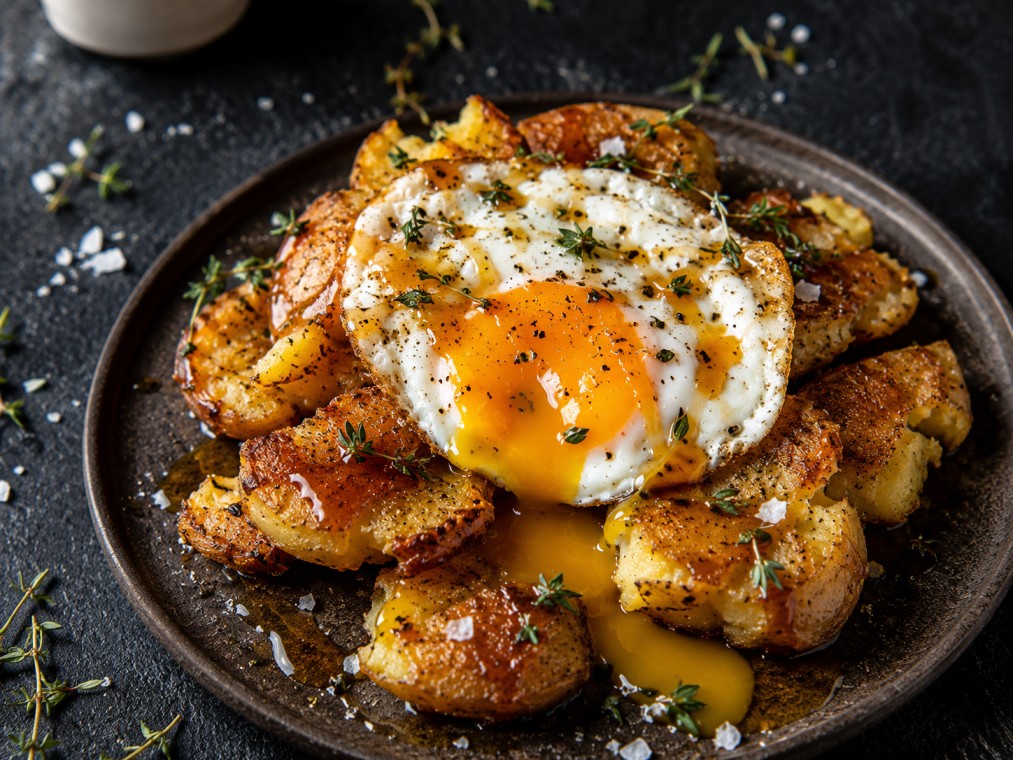
Prep time: 25 minutes | Serves: 1 | Approx. calories: 520 | Protein: 14g | Fat: 26g
When to make this: When you have worked hard and you want your breakfast to acknowledge that. When restraint has been your mode for several days and your body is asking for something satisfying in the most honest, physical sense of that word. When you want to eat something that makes you feel good about being alive.
There is nothing wrong with eating for pleasure. There is nothing wrong with fat and salt and something crispy in the morning. The question I ask is not whether a meal is indulgent but whether the ingredients have integrity — whether the fats are real, whether the carbohydrates are doing something useful, whether the food was made with attention.
Potatoes are genuinely nutritious — high in potassium, B6, and resistant starch when cooled, which acts as a prebiotic for your gut bacteria. Cooking them in olive oil rather than seed oils keeps the fat profile clean. Hot honey — chilli-infused honey — adds capsaicin, which supports circulation, and the small amount of raw honey provides enzymes and trace minerals. The fried egg on top is structural and perfect. This is not a guilty pleasure. It is a pleasure with a coherent nutritional story.
Ingredients
- 3–4 small waxy potatoes, boiled until just tender and cooled
- 2 tablespoons olive oil
- 1 large egg
- 1 tablespoon hot honey — or regular honey with a pinch of chilli flakes
- Flaky salt and black pepper
- Fresh rosemary or thyme, optional
- A small handful of rocket or watercress to serve, if you want some green
How to make it
The potatoes must be cold — boil them the night before and refrigerate. Cold potatoes have more resistant starch, which is better for your gut microbiome, and they also crisp more effectively. Place the cold potatoes on a board and press down firmly with the palm of your hand until they split open and flatten. Season generously.
Heat olive oil in a heavy pan over medium-high heat. Add the smashed potatoes in a single layer. Do not move them for 4 minutes — let the crust form. Flip carefully and cook another 3 to 4 minutes until deeply golden and crispy on both sides. Fry the egg in the same pan while the potatoes finish. Serve the potatoes topped with the fried egg, drizzle generously with hot honey, and add flaky salt and fresh herbs. Eat immediately.
Why it works: Cold potato resistant starch feeds gut bacteria and does not spike blood sugar the way freshly cooked starch does. Olive oil fat profile is anti-inflammatory and heat-stable. Egg choline supports cognitive function. Hot honey capsaicin supports circulation and provides a gentle metabolic lift. This meal is satisfying in the most physiologically honest sense — it gives your body what it asked for.
6. The “I am hosting but I want it to feel effortless” breakfast — Baked eggs in tomato with feta and herbs
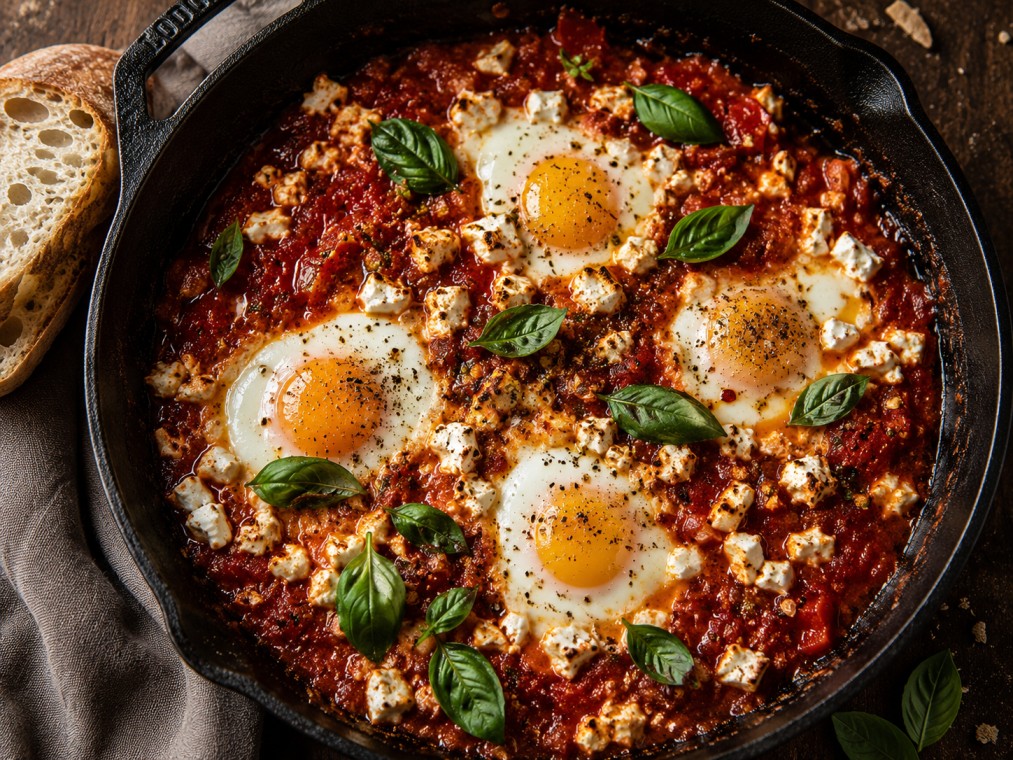
Prep time: 10 minutes prep, 15 minutes oven | Serves: 2 | Approx. calories: 380 per serving | Protein: 21g | Fat: 24g
When to make this: When someone is staying over and you want breakfast to feel considered without you being in the kitchen the whole time. When you want one pan, one oven, and the ability to sit at the table with your guest rather than stand at the stove. When the meal should feel like an occasion without requiring the energy of one.
Eggs baked in tomato sauce — shakshuka-adjacent, simpler, more Italian in feeling — is one of those recipes that does more than it should with very little. The tomatoes become jammy and sweet in the oven. The eggs set gently in the heat. The feta on top softens and browns slightly at the edges. The whole thing comes out looking like you knew what you were doing, which is exactly the feeling you want on a morning when someone else is watching.
Tomatoes cooked in olive oil release lycopene — an antioxidant that absorbs significantly better from cooked tomatoes than raw — in quantities that support cardiovascular health and skin protection from UV damage. Feta is lower in fat than most hard cheeses and provides calcium, phosphorus, and B12 in a form that is easier to digest than cow’s milk cheese for many people. The eggs anchor the protein. The herbs are not decorative.
Ingredients
- 1 tin (400g) good-quality whole plum tomatoes
- 3 tablespoons olive oil
- 2 garlic cloves, thinly sliced
- ½ teaspoon dried oregano
- ½ teaspoon smoked paprika
- A pinch of chilli flakes
- 4 eggs
- 80g feta, crumbled
- Fresh basil or flat-leaf parsley to finish
- Flaky salt and black pepper
- Crusty bread to serve
How to make it
Preheat oven to 190°C. Heat olive oil in an oven-safe pan or skillet over medium heat. Add garlic and cook for 1 minute until fragrant but not browned. Add the tinned tomatoes, crush them gently with a spoon, and add oregano, paprika, chilli, salt, and pepper. Simmer for 5 minutes until the sauce thickens slightly. Scatter half the feta into the sauce. Make four wells with the back of a spoon and crack an egg into each. Scatter the remaining feta on top. Transfer to the oven and bake for 12 to 15 minutes — 12 for runny yolks, 15 for set. Scatter fresh herbs over the top and bring the pan directly to the table with bread for scooping.
Why it works: Cooked tomato lycopene absorbs up to four times more effectively than raw, providing meaningful antioxidant and cardiovascular support. Feta provides complete protein and calcium in an easily digestible form. Olive oil fat enhances lycopene absorption. The eggs add choline and fat-soluble vitamins. This is a breakfast that nourishes two people with one pan and makes no mess.
7. The “I woke up already behind and I need something that takes four minutes and still counts” breakfast — Ricotta toast with honey, walnuts, and fresh fig
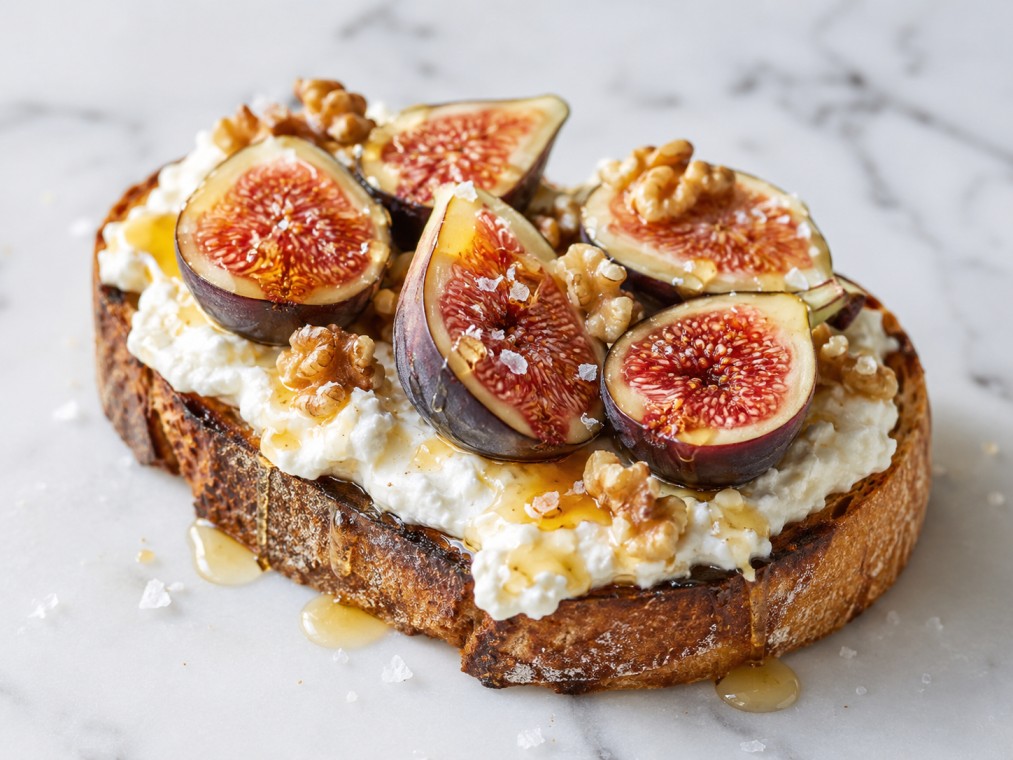
Prep time: 4 minutes | Serves: 1 | Approx. calories: 410 | Protein: 16g | Fat: 18g
When to make this: When you genuinely do not have time but you also know from experience that skipping breakfast makes everything worse by ten. When you want something that feels beautiful and considered even though it took less time than making coffee. When the morning has already decided to be difficult and you want at least this one thing to be easy and good.
No cooking. One bowl, one knife, one piece of toast. The ricotta is cold and creamy and takes a second to spread. The honey goes on while the toast is still warm and sinks slightly into the cheese. The walnuts add crunch and omega-3 fatty acids and the particular satisfaction of something that requires chewing. The fig, if it is a good fig, is the thing that makes the whole plate feel like a decision rather than an accident.
Ricotta is lighter than cream cheese and higher in whey protein — the fast-digesting protein fraction that reaches your bloodstream quickly and starts feeding your muscles and brain within twenty minutes. Walnuts are the highest plant source of omega-3 fatty acids and contain l-arginine, which supports arterial flexibility and blood flow. A ripe fig provides natural fructose for immediate energy alongside soluble fibre that slows its absorption. Raw honey contains amylase enzymes that begin carbohydrate digestion before the food even reaches your stomach.
This is not a consolation prize for a morning that got away from you. It is a genuinely good breakfast that also happens to take four minutes.
Ingredients
- 1 thick slice sourdough or seeded bread, toasted
- 3–4 tablespoons full-fat ricotta
- 1 tablespoon raw honey
- A small handful of walnuts, roughly broken
- 1–2 fresh figs, halved or quartered — or sliced pear, or fresh raspberries if figs are not in season
- A pinch of flaky salt
- Optional: a crack of black pepper, which makes the honey taste more interesting
How to make it
Toast the bread. Spread the ricotta thickly while the toast is still hot — it will warm slightly and become easier to spread. Drizzle the honey over the ricotta. Add the walnuts. Arrange the figs. Add flaky salt and pepper if using. That is everything. Eat it slowly if you can. The four minutes you spent making it deserves at least five minutes of your attention in return.
Why it works: Ricotta whey protein absorbs quickly and begins fuelling cognitive function within twenty minutes. Walnut omega-3s support brain health and reduce inflammation. Fig soluble fibre slows fructose absorption and prevents blood sugar spike. Raw honey enzymes support early-stage carbohydrate digestion. The salt on the honey is not an accident — it suppresses bitterness and amplifies sweetness without adding more sugar. This is the breakfast for every morning when you thought you did not have time for breakfast.
A note on making these yours
Every one of these breakfasts has a logic — a reason for the specific ingredients in the specific order. But none of them need to be made perfectly to work. You do not have crème fraîche? Use full-fat yogurt. Your figs are not ripe? Use pear. Your anchovies are the jarred paste kind? Still add them — they will still dissolve and still deepen the flavour, just less elegantly. The version you actually make and eat on the actual morning you have is worth more than the perfect version you save for a day when everything lines up.
Pay attention to how you feel at eleven o’clock after each of these. Not dramatically different. Just differently. That is the quiet return on paying attention to breakfast.
Frequently Asked Questions
Can I prep any of these the night before?
The potatoes for recipe five should absolutely be boiled the night before — cold potatoes have more resistant starch and crisp better. The tomato base for the baked eggs can be made the night before and stored in the pan; add the eggs and bake in the morning. The caramelised onions for the chicken livers will keep refrigerated for three days. Everything else is best made fresh — eggs especially do not improve with time.
I do not eat liver. Can I get the same iron from something else in this list?
The egg yolks across all seven recipes contain non-haem iron and B12, which support iron absorption even if they do not replace it. For haem iron specifically, the only substitution that comes close within this category is dark chicken meat or beef. If iron deficiency is genuinely your concern, the chicken liver recipe is worth trying once before deciding it is not for you — most people who have been put off by liver have only ever had overcooked liver, which is a different food entirely.
How do I know which breakfast to make?
The same way you know which smoothie to make: you notice what your body is asking for before your brain overrides it. The craving for something warm and heavy usually signals a need for grounding — fat, protein, something cooked. The craving for something fast and light usually signals that your body is already in motion and does not want to slow down. The craving for something sweet usually signals that your blood sugar dropped overnight and wants a gentle lift rather than a spike. These seven cover most of those states. Start with the one whose description sounds like your morning.
Are these breakfasts suitable for every day?
Every one of these can be rotated daily without concern. The chicken liver recipe is best two to three times a week rather than daily — liver is nutritionally dense in a way that daily consumption over long periods can lead to vitamin A accumulation. For everything else: daily is fine, and the nutritional consistency is part of how they work. A breakfast eaten once is an experiment. A breakfast eaten every Tuesday for a month is a practice.
About The Author
